Despite the reports from the Scientific Committee and the Scientific and Economic Committee on the definition of the glass-eel quota (Réactions et Commentaires du Conseil Socioéconomique “Quota Civelle” sur le rapport du Conseil Scientifique en charge d’établir ce quota pour la saison 2026 – 2027 – Anguille Responsable ), the Ministry for Ecological Transition has unilaterally decided to set the quota for glass eels at 43 tonnes(La définition des quotas de civelles: un dialogue de sourds – Anguille Responsable). This represents a 34 % reduction in the quota allocated for 2024–2025 (65 tonnes) without any well-founded and widely accepted scientific justification.
A purely political and technocratic choice.
Given the detrimental nature of the quota’s calculation for the French fishery – total mortality of glass eel released after capture; failure to take into account the sharp decline in the number of fishing licences (-60 %); and, above all, the very sharp decline in the number of fishing days in the maritime area (the zone to which the majority of the glass eel quota is allocated) – the authorities have decided on a quota level corresponding to a 50 per cent probability of achieving the management objective: a 60 % reduction in the exploitation rate compared with the reference period set from 2002 to 2008. It should be noted that France proposed, without being asked to do so by the European Commission, a 60 % reduction rather than the 50 % reduction required by the objectives of Regulation (EC) No 1100/2007. Furthermore, the two-year projection, as requested by the former Minister for Ecological Transition, Ms Pannier-Runacher, was open to question given the available data on eel population dynamics. Consequently, stipulating in the previous 2025 decree that the glass eel quota for the 2027 season should be set at a maximum of 43 tonnes was a purely technocratic decision and fell far short of the Scientific Committee’s estimate for this year – which, whilst already restrictive, stood at 57.4 ton
The social and economic collapse continues.
But what do this administration and those who govern us want at a time when operating costs are becoming increasingly heavier on the small-scale fishing sector?
Given the current number of fishermen engaged in this activity, this decision will result, overall, in a potential loss of around 10,000 euros per fishing enterprise (473 in 2026). And all this for nothing – and certainly not in the name of protecting the species!
Although a ship-breaking plan has been announced in the maritime zone to “support the withdrawal of fishing units”, this paints a rather bleak picture for the future of a fishing industry that is a cornerstone of our regions’ tangible and intangible heritage.
A European market for glass eels that is likely to come under pressure.
The glass eel fishing sector in France largely supplies the market for direct or indirect consumption (farming for restocking and for consumption) and almost entirely supplies the restocking market (a market that is not particularly dynamic and faces competition from the production of young eels in northern Europe).
Since the United Kingdom’s departure from the European Union, France and Spain have shared the consumption market.
French production for the 2026–2027 season has been set by ministerial order at 17.2 tonnes for consumption. Spanish statistics suggest that the 1,000 fishing licences granted could bring around ten tonnes onto the market, of which, in theory, 60 % is destined for restocking (Regulation 1100/2007).
We should therefore have just over 20 tonnes on the European market for direct or indirect consumption, whilst we know that the European aquaculture sector requires at least this quantity to operate. It will be difficult to satisfy both consumer markets: the Spanish market (which is important for the French fishing sector in November and December and drives prices up) and the Northern European market (which accounts for the majority of demand from the start of January and offers a lower price per kilogram). However, it is important to maintain these two markets to avoid eventually finding ourselves in a situation where the aquaculture sector effectively holds a monopoly.
A social and heritage dimension that must be taken into account by our national and European elected representatives.
Further weakening small-scale, traditional fishing – which forms part of the heritage of our maritime and inland regions in Europe (see the PECOSUDE programme and the DIMPAT project, coordinated by IFREMER) – is not a reliable solution. A fishing port is not simply a place to store boats; it is a hub of life, trade and social interaction that contributes to the cultural diversity of Europe’s regions. These activities help to provide local, high-quality produce. They form the basis of a processing sector that is essential to the reputation of European gastronomy. Every effort must be made to incorporate this heritage dimension into the discussions and negotiations aimed at establishing a sustainable development policy in Europe.
Neither in France, nor to any greater extent at the European Commission, we are going in that direction. The heritage dimension of these age-old fishing activities – some of which are listed as UNESCO Intangible Cultural Heritage – and their preservation, which is essential to the quality of our local cultural identities, do not seem to interest those who manage these activities as mere economic assets that can be easily replaced. Protecting small-scale fishing means protecting our environmental assets; it is time to realise this.
A David and Goliath battle.
The expansion of human activities has had a deep impact on marine and freshwater resources and their environments. All experts agree that simply regulating fishing, or even banning it, will not restore these resources to the state they were in until the mid-20th century.
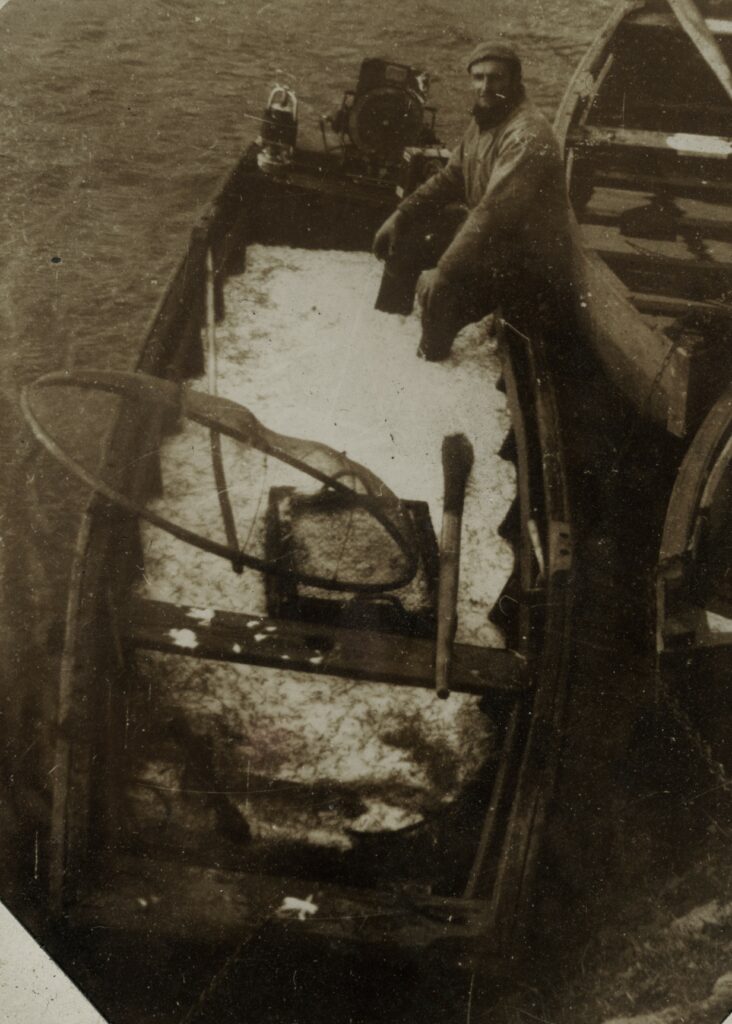
The photograph below, taken in the Adour river basin, shows the abundance of glass eel catches that could be made during the night in few hours using a single hand-held sieve. While this was certainly not a common occurrence, it illustrates the high concentrations of eel fry that used to migrate upstream along river banks in the mid-20th century.
Obstructions to ecological continuity along major migratory fish axes and the chemical contamination of our watercourses are major causes of the decline in these populations. In the Mediterranean, it has been estimated that only 38 per cent of the potential habitats of the European eel can be naturally colonised by the species. The same is true for many countries that have artificialised their watercourses and developed hydroelectric power generation. Unless the impact of these disturbing factors is reduced, it is futile to hope for a return to the levels of migratory fish populations – and more specifically, eels – seen until the mid-20th century.
Unfortunately, the implementation of a sustainable development policy is a negotiation between stakeholders whose influence is directly proportional to the direct economic significance of their activities.
The eel fishing sector and, more broadly, the European eel industry (fishing, farming and processing of the species) have assets and production values that are, at best, measured in millions of euros. The hydroelectricity sector in Europe has assets and values measured in billions of euros. The construction of fish passes – when they work – and their operation involve substantial investment, the importance of which is not always fully appreciated by those who view environmental goods and services solely through an economic lens.
The simplest solution is therefore to eliminate fishing to make the problem go away; fishing is a minor stakeholder in the purely economic context that primarily guides our policy makers within the framework of the so-called implementation of a sustainable development policy.
But it is time for those who govern us in Paris and Brussels to realise “that economic and social development cannot be separated from cultural development” if we do not want our rural and coastal areas to become nothing more than museums of our past identities.
Professional fishermen are not asking for additional rights, but just the respect of their knowledge and their environments by taking into account the heritage value of their activities. The recovery of the eel population will require a genuinely participatory approach, drawing on expertise shared by all stakeholders in sustainable development (including the professionnal fishers), rather than being decided by administrators whose sole aim is to promote certain sectoral policies without considering the environmental impact of their decision.