Preamble
AFPMAR, faced with the incongruities, incoherences and false messages spread on social media by a number of organisations, wishes to continue informing on the biology of the eel, the economic sector linked to this species, the elements of management of this resource and the significant efforts made, in particular by the professional fishing sector, in the restoration of the species. One of the important points that needs to be clarified concerns the determination of glass eel quotas and the basis on which these quotas are established.
France is the only country in the European Community exploiting the eel that has chosen to regulate its exploitation through quotas, and this for two main reasons:
- to facilitate control of the distribution of overall catches according to the allocation key of 40% for consumption and 60% for restocking;
- to enable the assessment of one of the management objectives of Regulation 1100/2007, which is a 50% reduction in fishing mortality relative to the 2000–2006 period. It should be noted that for the French management plan, the French administration set itself a more demanding target than what was required, since the management target was a 60% reduction.
The achievement of this management objective is assessed annually by a scientific committee which bases its work on the trend in glass eel recruitment as defined by the ICES working group, using a conservative approach: no effect of the reduction in fishing effort, and total mortality of glass eels after transfer to various European ecosystems. This assessment is then evaluated by a social and economic committee, including representatives of the eel sector, which raises a number of remarks and objections concerning in particular the representativeness of the curve used by ICES (International Council for the Exploration of the Sea), the failure to take into account the reduction in fishing effort, and the total mortality of glass eels transferred to other ecosystems. The competent administration then makes its decision based on technical and political considerations. It should be noted that in recent years, under pressure from the European Commission, a technically unjustified decision reduced the quota from 65 tonnes to 55 tonnes, then to 47 tonnes for the next season, which is likely to entail serious economic consequences for this small-scale fishing fleet.
How are glass eel quotas determined?
For several years now, fishermen have felt that glass eel quotas are decided on the basis of opaque scientific models that are often far removed from the realities on the ground. But how do scientists actually assess this resource? Do they count all the glass eels? What data do they use? On which rivers, with what means?
A question that often comes up among professionals: why is the data collected with precision in the field — in particular through modern digital monitoring tools — so rarely, if at all, integrated into the scientific assessments that are used to calculate quotas?
The aim of this article is not to question the need to preserve the European eel, nor to contest the work of scientists. It is to understand how the current assessment system actually works, what its limits are, and how field data could help to improve it.
1. Our rivers have changed profoundly since the mid-20th century
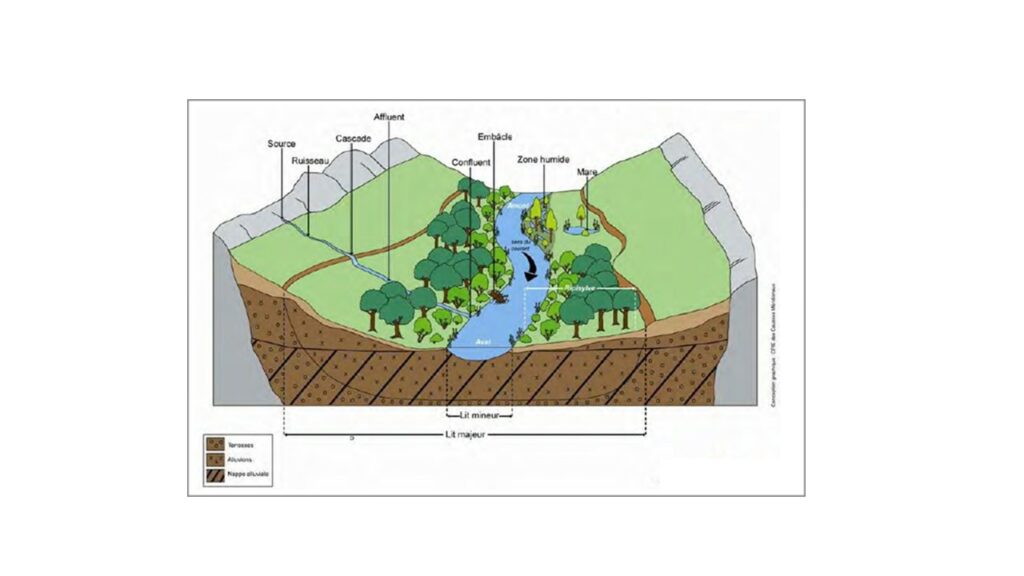
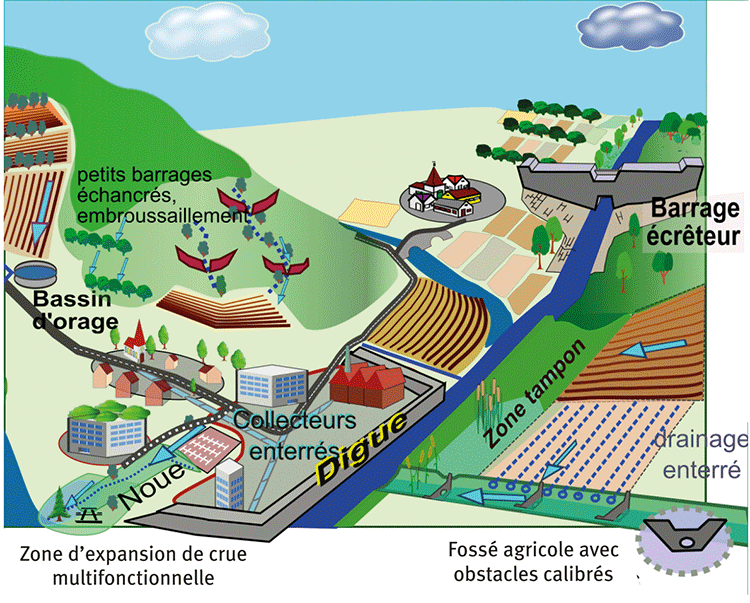
On the left a natural ecosystem composed of different elements that allow it to self-purify and have a high productivity – on the right a heavily modified ecosystem that is increasingly observed. The European Commission has finally admitted that many countries, including France, will not meet the objectives set by the Water Framework Directive and the Marine Strategy Framework Directive and that the assessments made on the state of aquatic ecosystems are far too optimistic.
To understand the debates on quotas, we must first put things in perspective. Scientists compare current recruitment levels to historical levels dating from the 1960s and 1970s. Yet the rivers and estuaries of that era have little in common with those of today.
Between 1950 and 1990, large hydraulic projects multiplied: dams, locks, channelisation, marsh drainage, urbanisation of estuaries, intensive agriculture, hydroelectricity. The degradations are considerable today and often irreversible.
France has more than 100,000 obstacles to water flow on its rivers. More than 50% of French wetlands have disappeared or been severely degraded over the course of the 20th century.
Populations of migratory fish — salmon, shad, lamprey, eels — depend directly on ecological continuity, wetlands and access to small tributaries. The size of an aquatic population depends on the area and productivity of the habitats it occupies. Yet since the mid-20th century, both these parameters have been simultaneously reduced: less accessible surface area, less productivity per hectare.
Ecological restoration only truly began with the Water Framework Directive (2000) and the Grenelle Environment Forum (2007). Its effects remain partial and very uneven across river basins. France, like many European countries, has moreover been called out for failing to meet the objectives of the Water Framework Directive and the Marine Strategy Framework Directive.
This raises an important question: can we directly compare current recruitment levels to those of the 1960s–1980s when ecosystems have changed so profoundly?
2. How do scientists actually assess the abundance of glass eels?
Methods exist for assessing in absolute terms the upriver migration of glass eels in a given estuary — as shown, among others, by the European project INDICANG. Yet the current system does not rely on these direct measurements. It is based on relative indicators, constructed from a few historical data series, a few rivers and a few sampling stations.
These indicators do not express an absolute volume of glass eels, but a trend relative to a reference period. This methodological choice has important consequences for how signals of recruitment recovery can — or cannot — be detected.
The main French monitoring stations
- Vilaine — fish trap at the Arzal dam. Validity as an indicator of estuarine abundance not established. The catch series was abandoned from 2015.
- Loire / Adour — professional catches and CPUE. Series not integrated into the model since 2008.
- Gironde — scientific surveys (vessel Esturial), focused on the impact of the Blayais power plant. Catch series not integrated since 2008.
- Sèvre Niortaise — professional catches. Series not integrated since 2008.
An important fact: from 2008 — just two years after the reference period adopted (2000–2006) — French fishery catch data is no longer integrated into the model. This interruption deprives the relative abundance index of its most directly representative information about the reality of Atlantic estuaries.
Consequence: a heterogeneity of data series without any real validation of their relevance. Some data come from dams, others from professional catches, others from scientific surveys, others still from commercial data collected at different times, some discontinued, others continuing. Some measure river recruitment, others estuarine. All these data are then grouped together, then mixed with equally disparate Mediterranean data with the same weight in the statistical treatment, without the models used taking into account either the relevance or the heterogeneity of the data. Yet the purpose of this trend curve is not only to show the decline in estuarine recruitment, but above all to see, after the implementation of eel management plans, how estuarine recruitment is recovering and first and foremost in the central zone of the colonisation range, that is to say in the Bay of Biscay.
3. The role of WGEEL and the construction of the European glass eel recruitment index
The WGEEL (Working Group on Eels – working group on the European eel) is the international scientific body responsible for assessing the European eel. It is made up of scientists appointed by national administrations, responding to a terms-of-reference letter from the European Commission that defines the objectives of the expert report (terms of reference). WGEEL uses information from across Europe: France, Spain, Portugal, Denmark, Norway, the Netherlands, Germany, the United Kingdom, Sweden… compiled into national reports.
WGEEL compiles data from across Europe and aggregates it into two major recruitment indices: “North Sea” (North Sea and Skagerrak) and “Elsewhere” (Atlantic and Mediterranean). It is this latter series — “Elsewhere” — that is retained for the calculation of French quotas.
A little-known point: For several years, France has no longer been providing a national report to the WGEEL working group. Neither the catch statistics, nor the fishing effort data of French professional fishermen are officially transmitted to this scientific body.
A very serious problem of representativeness of the compiled data.
The “Elsewhere” series mixes data from the Atlantic coast — directly concerned by the French and Spanish fishery in the Bay of Biscay — with Mediterranean data from very different ecological conditions. This mixing is done without weighting: all series are incorporated on an equivalent basis to estimate the overall trend. Result, it is the historically longest series that are taken into account, but not necessarily the most relevant, that carry the most weight in the trend.
Thus, it can be observed that the evolution of the index is strongly influenced by two Spanish data series from the Ebro and the Albufera lagoon — Mediterranean sites whose fishery importance is marginal compared to the major Atlantic fisheries. The question of their actual weight in the index used to drive French quotas has not received a public and transparent answer, nor does it seem to pose a problem to the accredited experts.
A little-known decision, with important consequences: In February 2021, the European Commission unilaterally modified its terms-of-reference letter to WGEEL. Initially, the approach incorporated all human pressures on the resource. The new terms-of-reference letter (defining the terms of reference of the expertise) imposed an approach focused solely on regulating fishing. The working group, unable to respond to this request with the available data, defaulted to the precautionary approach: “zero catch”. This modification of the terms of reference is the direct cause of the targeting of scientific recommendations on fishing since 2021. It was not the subject of any consultation by the European Commission with the Member States and it constitutes a technocratic decision not in conformity with the spirit of Regulation 1100/2007.
4. Apparently sophisticated statistical models — but driven by human choices well guided by administrative terms-of-reference letters.
Once the data has been collected, it is subjected to various statistical treatments. What is essential to understand is that each of these treatments involves human choices and that these choices have a direct and considerable influence on the final quota as defined by the French Scientific Committee.
The basis of the estimation is the “Elsewhere” trend curve defined by the ICES eel working group from various data collected on the Atlantic coast (including the English Channel) and the Mediterranean.
The trend of the abundance indicator is defined using a generalised linear model which makes it possible to model the average (or median) trend, its likelihood envelope and the series that have the most influence on the overall trend. One can already see here the influence of a first choice that is not trivial: which series to choose, what weighting to apply (the option, highly debatable, chosen by the experts is: no weighting); what reference period to retain, knowing that the decline of the abundance index is probably not simultaneous in the Atlantic and the Mediterranean. This choice, as we mentioned above, has led to the identification of a very strong weight of Mediterranean series on the trend in the “Elsewhere” zone that concerns the French glass eel fishery.
This trend curve will serve as the basis for calculating French quotas, carried out by a national group of experts most of whom are members of the ICES eel group. This national expert group responds to a terms-of-reference letter (mandate) defined by DGAMPA (example of the 2025 mandate) and no longer by the European Community, in order to define:
- the reduction in exploitation rate achieved for the 2023–2024 season compared to a reference period;
- the quantity of glass eels that could be harvested from the natural environment for the 2025–2026 season on the one hand, and the quantity of glass eels that could be harvested for the 2026–2027 season on the other, so as to achieve the objective of a 60% reduction in (fishing) mortality compared to the 2004–2008 reference period, with a probability of 25, 50 and 75%;
- the feelings of professionals about the 2024–2025 fishing campaign as assessed from the questionnaire on the level of recruitment observed, the transmission of which was ensured by CNPMEM.
Here the fate of the economy of small-scale inland, estuarine and even coastal fisheries will be decided on the basis of a number of choices.
The first is to use as a “baseline” the trend in glass eel recruitment as defined by the ICES eel working group, whose biases in estimation we have already noted above.
The second is the acceptable level of risk, which for the same chosen scenario gives very different results:
The model runs several thousand simulations to estimate, for different quota levels, the probability of achieving the management objective. The result is not a single figure, but a probability of achieving, for a given quota level, the 60% target. It is then up to the operator to choose the level of caution — and this final choice is entirely human.
Thus, for the 2025–2026 season, the modelling makes it possible to estimate, for a given quota level, the probability of achieving the 60% reduction objective: 75% probability with a quota of 26.1 t; 50% probability with a quota of 34.9 t and 25% probability with a quota of 45.4 t.
While one can understand that the administration chooses the option of at least a one-in-two chance of achieving the objective within a precautionary management framework for a species in sharp decline, it is however difficult for professional fishermen to understand the other choices that strongly condition the quota level:
- Why not take into account the sharp reduction in fishing effort (reduction of more than 50% of vessels since the start of the reference period, accentuated in recent years by a greatly restricted fishing time), when the European INDICANG project has clearly shown that the exploitation rate is determined by the volume of water filtered, hence by the number of fishing gear in the water and the number of trips.
- Why does the administration pass over in silence the fact that effectively taking into account the reduction in fishing effort makes the definition of a quota pointless;
- Why consider that the fate of a glass eel destined for restocking is the same (i.e. 0% survival) as that of a glass eel that is directly consumed or destined for the production of eels for consumption;
- Why pretend to ignore the difference between what is estimated by the models and what is observed in the field by professional fishermen.
- Why continue to impose such restrictive fishing periods not in conformity with Regulation 1100/2007 when a quota exists. Common sense easily allows us to understand that a quota taken in 1 or 3 months does not change much in terms of fishing mortality, but would allow multi-activity professional fishermen to better manage their activities.
- Why pretend to incorporate the observations of professional fishermen into a recruitment trend curve that in no way takes into account the major glass eel fisheries.
- The least one could do would be to estimate plausible scenarios in order to have a genuine risk analysis that is not biased against professional fishermen. For example, taking a scenario of 50% survival of transplanted glass eels compared to glass eels left in the environment; assuming a link between the reduction in fishing effort and fishing mortality. This would already provide a first, more realistic picture of the reduction in the ecological footprint of fishing.
All these choices are questionable and cannot remain unanswered, otherwise it will only confirm in the minds of professional fishermen that both the European and national administration is only seeking to make them disappear, whereas it is clear that the other destructive effects of activities other than fishing have not been reduced, as the European Commission has very recently (finally!) acknowledged.
5. Commercial fishing: the adjustment variable on which public authorities act.
This is a point that is rarely explained clearly. Today, commercial fishing is probably the variable most directly controlled by public authorities in eel management. And above all, professional fishermen are considered by the administration as politically weak actors in the negotiations aimed at putting in place supposedly appropriate regulations.
Why? Because fishing is visible, controllable, quantifiable and immediately adjustable via quotas. Concretely, it is possible to quickly reduce catches, reduce the number of licences, shorten seasons, tighten controls or lower quotas.
By contrast, the other major causes of eel decline evolve much more slowly and act in an insidious manner with delayed effects: river fragmentation, dams, hydroelectric turbines, habitat destruction, artificialisation of estuaries, diffuse pollution, wetland drainage and climate change.
These factors have nonetheless long been recognised as having an impact on migratory fish. But they are not subject to the same level of immediate constraint as fishing. Hydraulic structures, even obsolete ones, remain present and are poorly adapted to facilitate ecological continuity, habitat restoration is progressing slowly and ecological continuity policies take several decades. France, like many European countries, has just been accused of laxness in meeting the objectives set by the Water Framework Directive and the Marine Strategy Framework Directive.
This creates today an important imbalance in resource management: fishing bears a very large share of the conservation effort, while the other factors of mortality and habitat degradation remain much more difficult to correct quickly and effectively. This was clearly stated in the European Parliament report of November 2023, but the European Commission did not want to hear it!
This does not mean that fishing has no impact. But it raises a legitimate question: is the effort demanded of fishermen proportional to the effects of fishing on the decline of migratory species? The answer is clearly NO.
6. The blind spot: the non-use of data collected by the French glass eel fishery.
Today, fishermen and fish merchants use digital tools that record in real time the catch dates, volumes, areas, times, actual effort with a significant effort of validation and control at source. These systems — VisioCapture, Visiomer, regulatory traceability — produce standardised, numerous, precise and up-to-date data, directly from the exploited areas.
This data does exist and is centralised by the administration. Yet it is not integrated into scientific assessments.
Scientists often respond that historical series must remain homogeneous to allow comparisons over time. This argument is acceptable, but is hardly respected for the database used by WGEEL.
The necessary reliability of this database, on which a large part of the diagnosis rests for classifying the European eel on the IUCN Red List, should lead us to propose another option based on a truly participatory approach involving all the stakeholders in the exploitation, management and valorisation of the eel in Europe: to re-explore existing databases to build a more reliable index based on current digital data in order to test their consistency and improve the quality of the glass eel recruitment trend curve.
What the currently unused data would make possible:
→ A more precise estimate of actual recruitment in Atlantic estuaries
→ A better measure of effective fishing effort
→ Faster detection of recruitment recovery or decline signals
→ Model calibration anchored in contemporary field realities
7. To conclude: The questions and interrogations emerging from the French eel sector.
In the face of growing complexity in assessment models and management decisions, many questions are emerging today among fishing professionals, fish merchants and field operators.
Among the subjects regularly raised:
- what exactly are the French stations being used?
- what methodologies are applied on each basin?
- which series are still active?
- how are lost habitats taken into account?
- why are modern digital data not more widely integrated?
- what exact influence do statistical assumptions have on the proposed quotas?
These questions do not call into question the need to preserve the European eel. They rather reflect a growing demand for dialogue, transparency, pedagogy and coherence of assessment tools.
The European eel remains a fragile species, and no one contests the need to preserve it. But effective and sustainable management can only be based on quality assessments that are transparent and connected to the realities of the field.
The professionals of the glass eel sector today have the knowledge, the tools and the legitimacy to contribute to improving these assessments. It is in the dialogue between science and field stakeholders for a genuine coherence of data and a true methodological transparency that a management that is at once credible, effective and accepted by those who live and endure it every day will be built.